
11 October 2026
Why Nobody Is Joining Your Event (and How to Fix It)
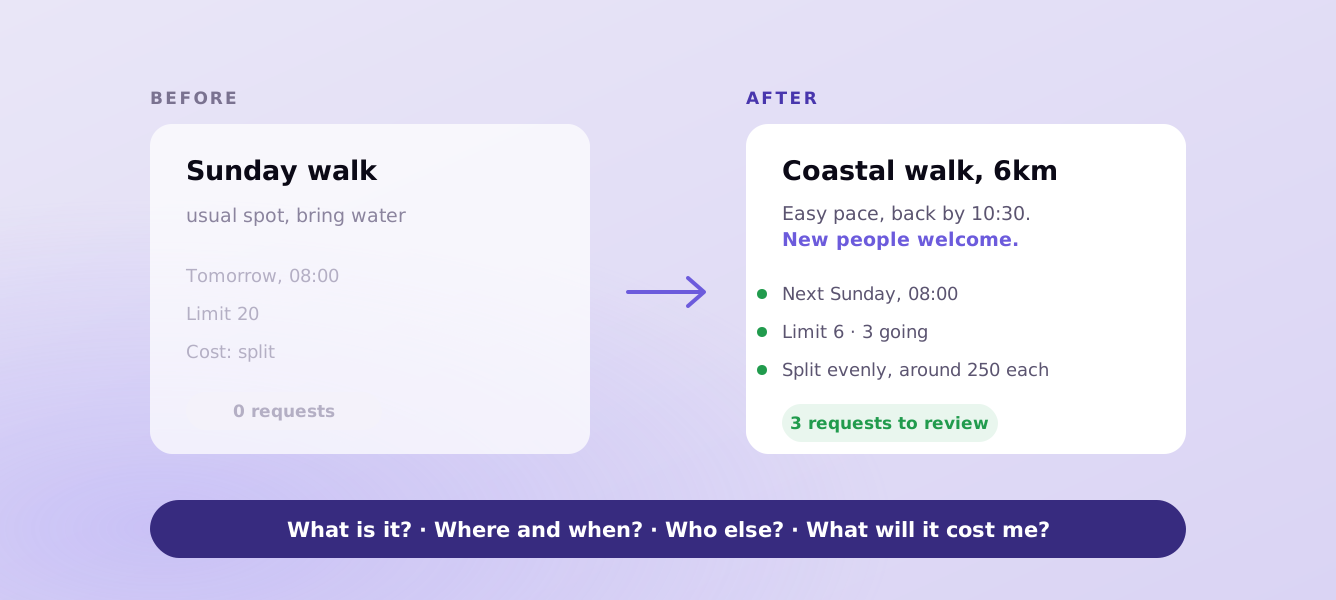
You created an event. You picked a good spot, you chose a time that works, you pressed publish, and then you watched nothing happen. No requests. Maybe one, from someone who then went quiet.
This is the point at which most new hosts quietly conclude they are not the hosting type and stop. It is worth knowing that an empty event is almost never a verdict on you. It is usually one of about six fixable things, and most of them are fixable in under a minute.
First, the thing nobody tells you
People do not browse events looking for something to attend. They browse looking for a reason to say no. That sounds cynical and is actually good news: every gap in your event listing is a reason, and closing the gaps is mechanical work rather than a personality transplant.
Someone deciding whether to ask to join is answering four questions in a couple of seconds. What is this? Where roughly, and when exactly? Who else is going to be there? What is this going to cost me? An event that answers all four gets requests. An event that leaves one blank makes a stranger do the work of guessing, and strangers do not do that work.
The six reasons an event gets no requests
1. It is too soon
This is the most common one by a distance. An event posted for tomorrow evening is competing with plans people already have. Adults book their weeks. Post four to seven days out and you are landing in an empty slot rather than fighting an occupied one. Same event, same description, completely different response.
2. The description assumes context you have and the reader does not
“Sunday walk, usual spot, bring water” is perfectly clear to you. To someone who has never met you it is three unanswered questions. How far is the walk? Is this a stroll or a hard hike? Who is “usual” addressed to - is this an existing group I would be intruding on?
Write for a person who knows nothing. Say the distance, the pace, the terrain, roughly how long it takes, and what to bring. Specific detail does not narrow your audience, it is what gives people permission to come.
3. It reads like a closed group
Anything that hints at an established circle - inside references, “the usual crew”, a joke that only lands if you were there last time - reads as not for me. Even when you absolutely mean it as open.
The fix is one sentence, stated plainly: new people welcome, most of us will not know each other. It sounds almost too simple to matter. It changes the response rate more than anything else on this list.
4. The cost is ambiguous
Tolivi asks you to state who pays - you cover it, guests cover their own, split evenly, or free - and that is the floor rather than the ceiling. “Split evenly” on a booked restaurant still leaves the reader wondering whether this is a two hundred evening or a six hundred one, and someone who cannot tell will usually just not ask.
Name the rough number in the description. “Split evenly, likely around 250 each” removes the last reason to hesitate. Nobody has ever been put off by a host being straightforward about money.
5. The guest limit is sending a signal you did not intend
A limit of two is a date, whatever you meant. A limit of twenty on a first event looks like it will either be chaos or be cancelled, and people are wary of both. Four to eight is the range that reads as a real, comfortable, actually-going-to-happen plan.
There is also a mechanical effect. A part-full event is more attractive than an empty one, because attending is easier to picture. Eight spots with three taken looks alive; twenty spots with three taken looks like something that fell through.
6. The activity is fine but the framing is flat
“Coffee” is not an event, it is a beverage. “Coffee and a wander through the market, back by twelve” is an event. The difference is not enthusiasm, it is shape: a beginning, a middle, and a clear end. The end matters more than hosts expect. Knowing when something finishes is what makes it easy to say yes to.
What to do with an event that is already live and empty
You do not have to start from scratch.
- Rewrite the description with the four questions answered and the rough cost named.
- Move the date out to next week rather than this one.
- Bring the guest limit down to something that looks achievable.
- Add the one line that says new people are welcome.
- Check your profile. A host with no photo and nothing written is a stranger asking other strangers to trust them first. Your profile is doing more persuading than your event copy is. Connecting Instagram helps here too, and visibility is mutual - you see someone's if they can see yours.
The part that actually builds momentum
Here is what nobody says about hosting: your first event is the hardest one you will ever run, and your third is easy. Not because you improve that fast, but because by the third you have a couple of people who came before and will come again, and an event with two known faces in it fills differently from an event with none.
So the goal for a first event is not a full guest list. It is one person who would come again. That is a completely achievable target, and it compounds - which means running the same small thing on the same day of the week for a month will do more for you than four ambitious one-offs.
If you have not hosted at all yet, the host's guide walks through it end to end.
Common questions
How far ahead should I post an event?
Four to seven days is the sweet spot. Sooner than that and you are competing with plans people already made; much further out and it slips off the radar before it arrives.
Should I cancel if only one person joins?
No, run it. Two people doing something is a perfectly good evening, and that one person is the beginning of the group that makes your next four events fill. Cancelling on someone who said yes is also the fastest way to not get asked again.
Is it my profile or my event that is the problem?
If people look and do not ask, it is usually the event. If people ask and then go quiet, it is usually the chat - answer quickly and confirm the details, because silence after a request reads as the event not really being on.
Does a paid event put people off?
Cost is not the problem, uncertainty is. People will happily split a restaurant bill and will not ask to join when they cannot tell what they are committing to. State the rough number and the objection disappears.
What is the best kind of first event to host?
Something you were doing anyway, with a clear end time, capped around six. A walk, a coffee and a market, a games night, a run. Low stakes for you, easy to picture for everyone else.
An empty event is a draft, not a rejection. Answer the four questions, push the date out a week, cap it at six, and say that new people are welcome. Then run it for whoever turns up.